


SweaterLodge was selected to represent Canada at the Venice Biennale of Architecture, 2006.
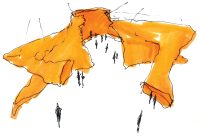
As a portrait of Western Canada’s culture of mass consumption and simultaneous love of the great outdoors, the major element of the installation was a giant polar-fleece sweater, 18 times human scale. Suspended inside the Canadian pavilion in Venice, this leviathan garment became a soft lodge; simultaneously cozy and critical. Absurdly silly yet environmentally embraceable.
The polar-fleece fabric was manufactured from recycled plastic pop bottles so the project comically probed the notion that our obsession with recycling as an act of absolution is a paradoxical fantasy of cities overrun by plastic water bottles. The installation included a film activated by pedaling specially modified bicycle /projectors, placed side-by-side so that visitors to the lodge could race and see who could fill their blue box first.
In the spring of 2011 the Museum of Vancouver remounted the installation with the SweaterLodge: Unlatched exhibition. This time, visitors were invited to remove their shoes and sit under the canopy of the big sweater to ‘levitate,’ and later could take some fabric home and make something. By sending a photo to the MOV Flickr site the public creations became a dynamic and crowd-sourced component of the exhibition.
Finally, the giant sweater was recycled once more, methodically cannibalized by the UBC outdoors club, to create almost 100 winter outfits.
The following text was written by Christopher Macdonald for the Venice Biennale catalogue, 2006:
“The installation at the Canadian Pavilion for the 2006 Venice Architecture Biennale was fashioned to provide an extraordinary experience in which issues of then-current urban and architectural cultures were explored and enacted.
The primary and most arresting manifestation of the project is the insertion of a hugely over scaled polar fleece sweater within the interior of the pavilion. The literal legibility of the sweater is supplanted by the creation of a sensually engaging backdrop for the duration of the Biennale.
The work referenced the emerging design culture of the city of Vancouver – a city in which an extravagant geographic setting established an unflinching measure of the activities associated with settlement and building. Vancouver’s urbanity is vitally contaminated by ever-present leisure activities, a pervading concern for environmental propriety and the essential optimism of a hugely diverse population preoccupied with the fabrication of home.
Vancouver’s contemporary housing has been reduced to a highly schematic and normative expression amplified through the marketing of associated lifestyles. In a social culture that privileges individual difference, the provision of domestic environments has developed into a monoculture of podium, tower and honed granite countertops that at best approximates the received virtues of a boutique hotel. The appropriation and resuscitation of such spaces can invite a kind of urban camping, appropriate to inhabitants who understand very well the virtues of the transitory.
While exhilarating in its expression of capital flow and conventions of domestic taste, design speculations often locate themselves along a cultural perimeter. The essentially blunt nature of current city building is probed through more agile explorations associated with landscape, furniture, set design and public art installation, always maintaining a critical and oftentimes quizzical regard for the brittle experiences of this place.
Pechet and Robb’s accomplishments include a number of installations within the public landscape that anticipate and even provoke the invention of new social practices. Within an urban realm that is largely unprecedented, such installations might be considered provisional invitations, awaiting the forcefulness of built presence to be fully accommodated in daily lives.
This critical regard between the routine and the improvisational not only characterizes the nature of Pechet and Robb’s practice, but also draws a direct resonance between the actions of the designer and those of the citizen. Each is obliged to undertake a revision of the environment as found in order to cultivate personal and nuanced meaning. The reading of the city is framed by individual and particular vested interests, which, in turn, intersect and collide to create a collective identity of layered communities.
In its allusion to the aboriginal constructions known as sweatlodge – structures built for the purposes of ritual purification and communal association – the SweaterLodge installation evokes another powerful strain of indigenous American culture, that of the trickster. In their use of puns, arcane allusions and double entendre, Pechet and Robb make manifest one valuable strategy for minority values to maintain a degree of invisibility within the realm of the more dominant culture. Allied with shifts in scale and a general inclination to decontextualize the familiar, the work operates as both visceral and intellectual stimulus – its final meaning constructed again and again by individual visitors to the Biennale.
The exquisitely ephemeral material of recycled plastic drink containers rendered in the monumental scale of a titan’s sweater transformed again into a comforting interior that evokes Barbarella while reminding us of architecture’s ultimate affiliation with the essential shelter of clothing…
A cipher for the order of complexity and substance that lies at the heart of this project we call architecture.”
Title
SweaterLodge Venice
Location
Venice Biennale in Architecture, Venice, Italy
Client
Canada Council for the Arts, Foreign Affairs, Canada
Completed
2006
Studio Team
Bill Pechet, Stephanie Robb, Andrew Maclean, Gabe Daly, Heidi Nesbitt, Mitch Gelber, Hanako Amaya
Project Team
Pechet and Robb Art and Architecture Ltd., Chris Macdonald (curator), Greg Bellerby (curator/commissioner), Jeremy Gruman (bicycle/projectors), Miriam Blume (fund-raising), Elia Kirby (rigging), Global Mechanic (film production), Robin Mitchell, Judith Steedman, Toby’s Cycles (bicycle modification), Blue Imprint Books, Aeroplan
Fabrication
Linda Chow and team, seamstress
Photos, Renders, Sketches
Scott Massey, Allyson Clay, Bill Pechet, Global Mechanic, James Eidse (the amazing woman on the beach)